Browse with music by Adam Holzman
Exhibit/Reclaiming the West
"We are often told the story the American West ended when the frontier was closed. But look closer, and you will see that the West was never fully won, lost, or settled.
It is being reclaimed every day—in the halls of the high courts, on the ancestral waters of the Pacific, and in the radioactive dirt of decommissioned bases.
This sequence of films maps the modern American frontier. It is the record of a living collision: where ancient sovereignty meets industrial appetite, and where the 'code of silence' is finally being broken by those who refuse to be erased. This is not a history of what happened; it is a document of what is happening now."

Emmy® Award Winning Documentary Films

Robert Lundahl’s films represent a compelling awareness of the modern American West, illuminating diverse narratives of struggle and resilience. His subjects range from descendants of Joaquin Murrieta protecting sacred antiquities against energy development and farmers striving to find viable cash crops amidst increasing challenges, to Marine Corps veterans bravely confronting the health effects of toxic pollution and tribal elders working to save salmon and their ancestral way of life—
All properties ©Copyright Robert Lundahl, Agence RLA, LLC, All Rights Reserved Across the Known Universe in Perpetuity.
Lundahl’s films and books are factually precise and historically accurate, masterfully portraying vast, unconquered landscapes and the communities of heroically resilient peoples who inhabit them.
"A river dammed, a culture silenced, and the decade-long fight to bring both back to life."
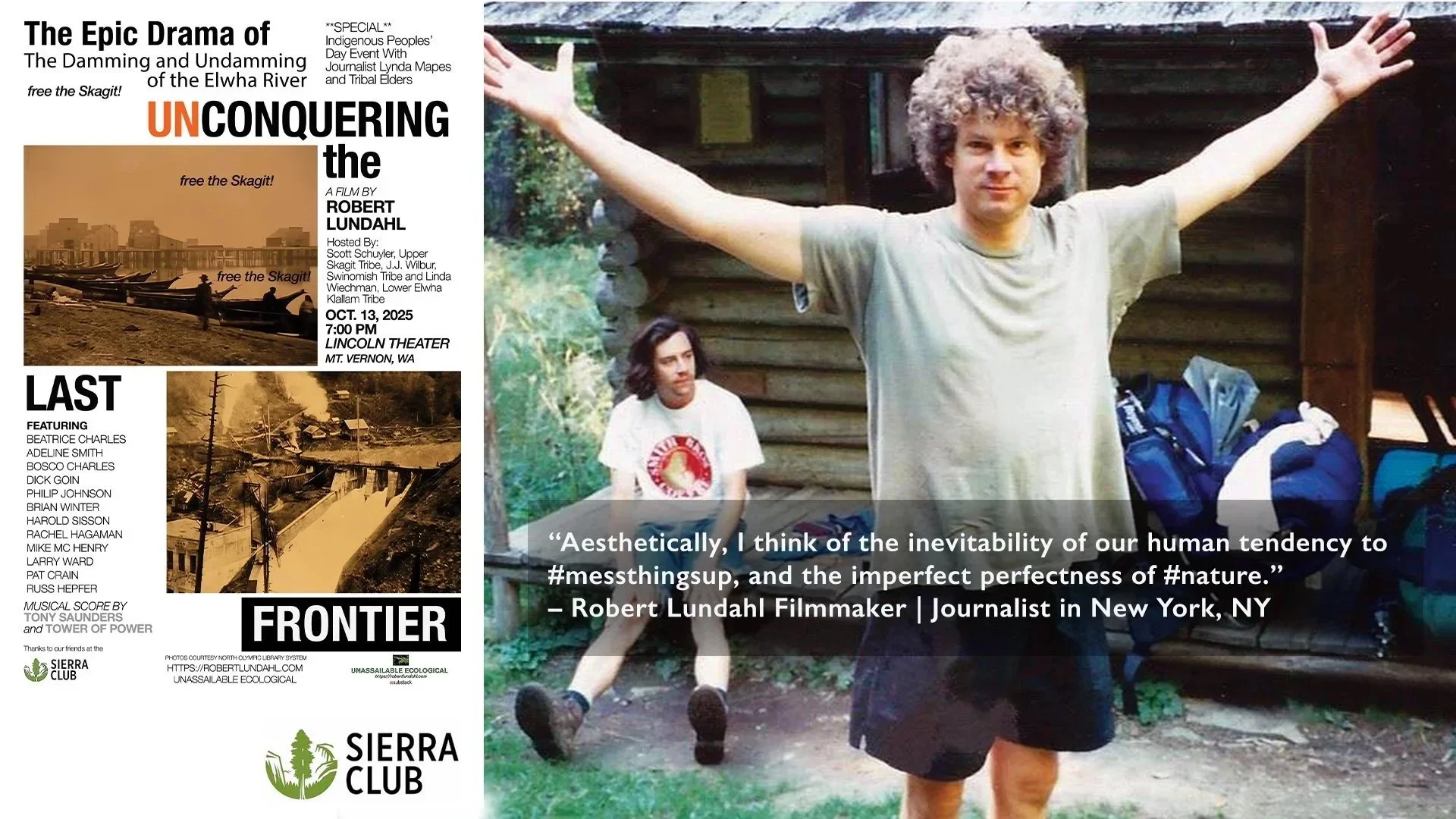
Unconquering the Last Frontier chronicles the epic saga of Washington’s Elwha River. For nearly a century, two massive dams stood as monuments to industrial progress—while simultaneously severing the lifeblood of the Lower Elwha Klallam Tribe.
I spent ten years documenting this collision between hydroelectric development and ancestral survival. Through the lens of the Pacific Northwest salmon crisis, the film captures a rare, intimate look at the "historic trauma" of colonization and the profound resilience required to restore an entire ecosystem. As the only film to address these specific cultural wounds, it remains a vital tool for environmental justice.
Distribution & Recognition
Broadcast: PBS, Free Speech TV.
Top Awards: First Place, EarthVision; Finalist, International Wildlife Film Festival.
Legacy: In the collection of The Smithsonian National Museum of the American Indian.
Technical Specifications
Format: 4K UHD (3840x2160) Digital Theatrical Print.
Original Capture: 62,400 ft of Kodak 7293 16mm Film.
Gear: Eclair 1.5, Angenieux Zooms, Nagra 4.2 S Audio
Song On The Water 4K Feature Trailer
Song on the Water
"They were told they could only fish if they could find their way by canoe. So they took to the water."
Following the brutal "Fish Wars" of the 1960s and the landmark Boldt Decision, Native American tribes in Washington faced a final, defiant hurdle: to reclaim their ancestral fishing grounds, they had to prove they could navigate them using traditional means.
Song on the Water is an award-winning ethnographic journey that puts you in the center of a modern-day miracle. I joined 50 indigenous crews and their communities as they paddled through open waters on an epic voyage to a traditional potlatch. This isn't just a documentary about a voyage; it’s a film about the rhythm of the paddle, the resurgence of a culture once forbidden, and the reclaiming of the Pacific Northwest coastline.
Distribution & Recognition
Broadcast: Premiered on KCTS 9 Seattle; aired over 240 times on 80+ PBS stations nationwide.
Release: Theatrical and Public Television.
Technical Specifications
Format: 3840x2160 / 2160P UHD Digital Theatrical Projection Print (4K).
Capture: Sony DSR-500 WS DV-Cam (Widescreen).
Audio: Single and Double System; Sony Walkman Portable DAT; Sennheiser Wireless and Shotgun Mics.
Who Are My People? 4K Feature Trailer
Who Are My People?
"In the hottest desert on the planet, a small group of elders stands between the world's energy giants and the burial grounds of their ancestors."
The Mojave Desert has become a modern-day gold rush for renewable energy firms. But this industrial expansion comes at a staggering cost: the destruction of ancient ecosystems, the exhumation of indigenous remains, and the bulldozing of sacred geoglyphs.
Labeled a "Flashpoint" by the LA Times, this film documents the collision of two competing value systems. I went into the heart of the desert to capture the resistance of Native American elders fighting to protect the integrity of a landscape that has been their home for millennia. Who Are My People? is an urgent inquiry into the ethics of "green" energy and a testament to those refusing to let their history be erased in the name of progress.
Distribution & Recognition
Theatrical Release: 5-State Tour (Oregon, South Dakota, Arizona, Nevada, California).
Impact: A primary resource for activists and tribal leaders fighting industrial encroachment on sacred lands.
Technical Specifications
Format: 3840x2160 / 2160P UHD Digital Theatrical Projection Print (4K).
Capture: Panasonic AG-HVX200 P2 HD System.
Audio: Audio Technica Shotgun Mics; Sennheiser Wireless Systems..
I am the camera's eye. I am the machine that shows you the world as I alone see it.
Dziga Vertov
Harvest Dreams 4K Feature Promo
Harvest Dreams
"Farming is more than a business; it's a legacy. But what happens when the land becomes worth more than the harvest?"
On Washington’s beautiful Olympia Peninsula, the agricultural landscape is changing forever. Harvest Dreams profiles four farming families across a full year of seasonal shifts, documenting a pivotal transition from traditional commodity crops to high-value organic and niche produce.
Filmed in an intimate, observational style, this documentary is at once touching and tragic. It captures generations facing impossible choices as rising land costs and housing development force some families out of business forever. Featuring a special bluegrass score by West Coast legends The Maddox Brothers and Rose Maddox, the film is a heartfelt portrait of those fighting to keep their hands in the dirt and their heritage alive.
Distribution & Recognition
Release: Theatrical Screenings (Washington State).
Music: Featuring a stinging, swinging score by Arhoolie Records, West Coast Bluegrass, and the indelible Rose Maddox.
Technical Specifications
Format: 3840x2160 / 2160P UHD Digital Theatrical Projection Print (4K).
Capture: Sony DSR-500 WS DV-Cam (Widescreen).
Audio: Sennheiser Wireless and Shotgun Mics.
We never really know what's around the corner when we're filming - what turn a story will take, what a character will do or say to surprise us, how the events in the world will impact our story.
Barbara Kopple
The Battle of Blythe 4K Short
The Battle of Blythe
"A scrappy 'freedom school' in a remote desert town became the spark of a movement—long before the world was watching."
What began as a personal journey back to the desert of my youth became a powerful encounter with a hidden chapter of California history. The Battle of Blythe chronicles the 1972 uprising of a Mexican-American community whose frustration with the public school system led to the creation of Escuela de la Raza Unida.
Narrated through the archives and memories of Alfredo Acosta Figueroa—a colleague of Cesar Chavez and a titan of the United Farm Workers—the film uncovers a "lost story" of Chicano Pride and Indigenous resilience. More than just a commemorative piece for the school's 40th anniversary, this film is a raw look at the racism and systemic barriers faced by those in the Palo Verde Valley, and the enduring legacy of a school that still stands today as a testament to empowering the poor.
Awards & Recognition
Winner:Best Documentary Film, Tulalip Tribes' Hibulb Cultural Center and Museum Film Festival (2020).
Legacy: Created in collaboration with the Figueroa Family to preserve the history of the first Chicano-Indigenous school in the United States.
Technical Specifications
Format: 3840x2160 / 2160P UHD Digital Theatrical Projection Print (4K).
Capture: Panasonic AG-HVX200 P2 HD System.
Audio: Sennheiser and Audio Technica Shotgun Mics; Sennheiser Wireless Lavaliers.
PayDirt 4K Feature Trailer
PayDirt
"When military secrets are buried in the soil, the truth becomes a matter of life and death."
PayDirt is a brutal, unassailable indictment of institutional fraud. This documentary series uncovers a "code of silence" surrounding toxic pollution at former U.S. military bases—sites where radioactive waste from 1950s nuclear tests and carcinogenic toxins were left behind in half-hearted "clean-ups."
As the 2008 economic collapse loomed, billionaire CEOs and government officials "cooked the books" to facilitate massive profit-taking, turning contaminated Superfund sites into residential developments and children’s play areas. From the radioactive history of the San Francisco shipyards to the "Dead Men Tell No Lies" investigation at El Toro, PayDirt exposes the liars, thieves, and hirelings who prioritized the bottom line over the health of veterans and their families. This is a cautionary tale of greed and a relentless search for accountability in a landscape of institutional deception.
Strategic Partners & Journalism
Collaborators: Created with Salem-News.com, SF Weekly, GreenAction, and The Law Offices of Angela Alioto.
Impact: A primary resource for environmental justice and legal action against fraudulent health and safety reporting.
Technical Specifications
Format: 4K UHD (3840x2160) Director’s Cut Digital Theatrical Projection Print.
Capture: Panasonic AG-HVX200 P2 HD System.
Audio: Audio Technica Shotgun Mics; Sennheiser Wireless Systems.
Post-Production: Robert Lundahl and Associates, Larkspur, CA.
Climate Change is Here: The Movie 4K Short
A Cinema Verité Record of Global Crisis
Born from the isolation of the 2020 COVID-19 pandemic,
Climate Change is Here: The Movie is a "cinema verité" short film that captures the exact moment a local emergency became a global realization. As uncontrolled wildfires devastated California and the Pacific Northwest that year, turning the skies a haunting orange, this film was captured using then-nascent Zoom technology. It documents a raw, unfiltered conversation between creators witnessing a world in flux, crystallizing the project’s central thesis: the environmental future we once feared has already arrived.
Bridging the Gap: From California to the Arctic
The film’s emotional and intellectual core is a cross-continental dialogue with Larry Merculieff, an Indigenous Unangan (Aleut) leader from the Pribilof Islands. While the American West burned, Merculieff provided a chilling mirror from the far north, describing an Alaska where the permafrost is melting and entire villages—over 140 of which now face imminent threats from erosion and flooding—are forced to relocate at immense cost. His insights reveal a cascading ecosystem collapse: sea ice barriers are vanishing, and shifting migration patterns are making traditional food harvesting nearly impossible for tribal people.
The Evolution of a Narrative
This project is a unique case study in how a single spark of inspiration can evolve across mediums. What began as an experimental digital recording between friends Robin Carneen and the filmmaker eventually grew into the "Climate Change is Here" radio series on KPFK. The profound stories and Indigenous wisdom captured in this short film didn't stop at the screen; they transitioned into the airwaves as documentaries and were eventually distilled into chapters for five separate books, proving that vital stories demand to be told in every format possible.
Why This Project Matters in 2026
In 2026, the message of this film is more urgent than ever. California continues to face record-breaking "conflagrations," such as the catastrophic January 2025 firestorms that killed 31 people and destroyed over 16,000 structures. By looking back at this 2020 "origin story," viewers gain a deeper understanding of the "whiplash weather" and accelerating shifts we now face daily. This film is not just a documentary; it is a historical marker of the moment we stopped talking about the future of climate change and started living it.
Distribution & Recognition
Release: Film Festivals. KPFK Radio Los Angeles 90.7, Apple Podcasts, Amazon “Gathering Fire: The Peopling of the Americas”
Repurposed footage: US Fish and Wildlife Service. Alaska Film Archives, Jeanie Greene/Heartbeat Alaska, CalFire, Various
Music: Free Music Archive (FMA)
Special Appreciation: Hunter College, City University of New York (CUNY), Pratt Institute
Technical Specifications
Format: 3840x2160 / 2160P UHD Digital Theatrical Projection Print (4K)
Capture: Zoom Recordings
Audio: Sampson Meteor
This film is licensable. info@studio-rla.com
Cinema is truth 24 frames-per-second.
Jean Luc Godard
I Met Dr. Munk 4K Short
I Met Dr. Munk
When I first met Dr. Walter Munk at a UCSD dinner in the early 2010s, I was struck by the monumental presence of the man known as the "Einstein of the Oceans." At 96, he spoke with a terrifying clarity about the future of our planet, providing precise estimates on the melting of the Greenland and Antarctic ice sheets and the subsequent sea-level rise. I was then in the midst of making my documentary, “Who Are My People?, which exposed how the "Green Jobs Program" under the Obama administration was facilitating a massive giveaway of public lands in the Mojave Desert to international firms—a "boondoggle" promoted by figures like Robert F. Kennedy Jr.
Walter had seen my previous film and was deeply intrigued by the connection between marine ecosystems and our changing climate. Our immediate rapport led to a friendship that grew out of a shared concern for the world’s ecological integrity. However, as our bond deepened, I was appalled to witness the unfolding struggle over his legacy: his historic home,
Seiche
Perched on the cliffs overlooking Black’s Beach, the home was not just a residence; it was a site of profound historical significance, having hosted the very first UCSD graduation.
Despite Walter's status as a pioneer who worked alongside Charles David Keeling and Roger Revelle to sound the alarm on climate change in the 1950s, the University of California moved to sell the property rather than preserve it as a climate-focused think tank. I became personally involved in a daunting effort to raise the $5–7 million needed to endow the home’s future, but the goal remained just out of reach. Seeing this vibrant hub of scientific creativity treated as a mere real estate asset felt like a betrayal of the man who had given so much to our understanding of the seas.
The following film,
I Met Dr. Munk
was born from a desire to memorialize these interactions and the friendship we shared. It is a story told with a touch of melancholy and a hint of sarcasm directed at a world that often fails to honor its greatest minds in favor of the bottom line. It serves as a tribute to the "Seiche spirit"—a reminder of the urgent warnings Walter gave and the enduring legacy he left behind, even as the physical walls of his sanctuary were passed into private hands.
This short film is a companion piece to my broader work on the climate crisis, including the podcast and film Climate Change is Here. It is an intimate look at a global icon, captured through the lens of a personal encounter that forever changed my perspective on the stakes of the environmental battle we face today. Enjoy the film, and may it inspire the same "stunning clarity" in you that Walter Munk once inspired in me. .
Distribution & Recognition
Release: Film Festivals. Apple Podcasts, KPFK, Los Angeles 90.7, YouTube
Repurposed footage: UCSD, The Walter Munk Foundation For The Oceans
Music: Free Music Archive (FMA)
Special Appreciation: Hunter College, City University of New York (CUNY), Pratt Institute
Technical Specifications
Format: 3840x2160 / 2160P UHD Digital Theatrical Projection Print (4K)
Editing: Adobe Premiere Pro
Audio: Sampson Meteor
This film is licensable. info@studio-rla.com
A Dream of Seiche 4k Short
Robert Lundahl's companion film, "A Dream of Seiche," serves as the poetic and architectural counterpart to the more biographical “I Met Dr. Munk.” While the latter focuses on the man, “A Dream of Seiche” focuses on the physical space as a vessel for his intellectual legacy.
The film is significant to the controversy for several reasons:
Immortalizing the "Think Tank" Concept: The film explicitly presents the home as "The Walter Munk Global Ocean Think Tank," capturing the intended vision of Mary Coakley Munk and her supporters. It argues visually that the house was not just a residence, but a specialized environment designed for scientific collaboration and climate reflection.
The House as a "Seiche": The title plays on the name of the house, which Munk titled after a "seiche" (a standing wave in an enclosed body of water). The film treats the architecture as a metaphor for Munk's work—a place where ideas resonate and amplify.
Distribution & Recognition
Release: Investor Community. Apple Podcasts, KPFK Radio, Los Angeles 90.7, YouTube
Repurposed footage: UCSD, The Walter Munk Foundation For The Oceans
Music: Free Music Archive (FMA)
Special Appreciation: Hunter College, City University of New York (CUNY), Pratt Institute
Technical Specifications
Format: 3840x2160 / 2160P UHD Digital Theatrical Projection Print (4K)
Editing: Adobe Premiere Pro
Audio: Sampson Meteor
How do we get utopian thinking in a dystopian world? These days we aren't talking to each other - we're screaming and trying to hit each other over the head with rocks and sticks.
A primitive fury has been unleashed by a president who has no culture, who cannot read, and who wants to determine power and aggression.
Carolee Schneemann
Sacred Glass 4K Short
Sacred Glass: The Art of Lisa Maywood
A Shared Language of Craft and Communication
While developing communications for the historic St. James-By-The-Sea in La Jolla, I met master artist Lisa Maywood. Our collaboration was built on a unique commonality: we were both alumni of USC with professional roots in the world of advertising. We connected instantly over her precise explanations of her medium—a clarity born from a master who has spent decades perfecting a discipline. This connection became the catalyst for a film that looks past the surface of the glass to the meditative soul of the work.
International Pedigree and the Artistic Leap
Lisa’s approach is anchored in a rigorous three-year tenure in Switzerland, where she exhibited at the Musée Suisse du Vitrail and Arts Visuels au Garenne. Her award-winning designs for Swiss chalets and work at Glasmalerei Peters in Germany solidified her reputation before she returned to the U.S. to found her own studio, Verre Designs, in 2003.
A Meditative Cinema Verité Study
Filmed in a methodically paced cinema verité style, Sacred Glass is a study of focus and stillness. While the windows illustrate biblical scenes, the film’s intention is a meditation on the discipleship of the art-making process. It highlights a fine arts approach to restoration, treating the rendering of light as a spiritual purpose in its own right. The camera captures the same quiet intentionality found in the 1920s illustrative style of these windows, which share the bold, narrative power of WPA-era murals and the works of Diego Rivera.
Distribution & Recognition
St. James By-The-Sea Episcopal Church
Episcopal Diocese of San Diego
Technical Specifications
Director/Cinematographer: Robert Lundahl
Format: 4K UHD (3840x2160) Director’s Cut Digital Theatrical Projection Print.
Capture System: Panasonic AG-HVX200 P2 HD.
Audio: Audio Technica Shotgun Mics; Sennheiser Wireless Systems.
Post-Production: Robert Lundahl and Associates, Solana Beach, CA.
Aztec Sickness 4K Short
Aztec Sickness (Save the Geoglyphs)
A High-Stakes Intersection of Aerial Documentation and Indigenous Futurism
In 2014, the Colorado and Mojave Deserts faced an unprecedented industrial "emergency." With 250 energy projects in the permitting queue, the ancestral homelands of the Seven Nations—including the Yaqui, Chemehuevi, and Opota—stood at a precipice. This film was born from the urgent need to hold developers accountable through a permanent recording of physical evidence and GPS locations that could not be ignored.
The Guardian’s Approval
Alfredo Acosta Figueroa, the "Geoglyph Guardian" and founder of the La Cuna de Aztlan Sacred Sites Protection Circle, granted filmmaker Robert Lundahl rare access to reveal these antiquities. Protected by a legal Memorandum of Understanding (MOU) with the Bureau of Land Management (BLM), Figueroa utilized this aerial cinematography to document sites—some over 200 feet long—sacred geoglyphs akin to Peru’s Nazca Lines. This ensured they were shielded from prying eyes and the destruction of off-road vehicles unaware of their fragility.
A View From Above
Produced with the vital assistance of the Desert Air Ambulance of Blythe, the film features remarkable aerial perspectives captured from the sky. Chuey Figueroa went aloft with the filmmaker and pilot, serving as a "spotter" to locate the massive intaglios. This never-seen-before footage, also central to the feature film Who Are My People?, provides a rare and intimate look at the "Creator’s Images" from the only vantage point that reveals their true scale.
Modern Bloodlines: The Music Video Evolution
To engage the next generation, Figueroa’s son, the musician and artist Jesus "Chuey Zapata" Figueroa, proposed a "Music Video" format. By fusing modern electronic studio technologies with lyrics reflecting his multi-tribal heritage,
Aztec Sickness (Save the Geoglyphs)
creates a sonic bridge between ancient earth drawings and contemporary youth culture.
"There's never going to be anything like this created again." — Chuey Zapata
Interactive Map & Locations
Explore the sacred landscape through the BLM Interactive Map.
: Located 15 miles north of Blythe, CA, on Hwy 95 GPS: 33.7996, -114.5301.
The Big Maria Mountains: Home to the human figure representing Mastamho, the Creator, measuring 171 feet in length.
Arizona Side Geoglyphs: Additional sites located across the Colorado River, documenting the vast spiritual geography of Aztlan.
"There's never going to be anything like this created again." — Chuey Zapata
Distribution & Recognition
Pomona College
U.C. Riverside
The Sacred Places Institute
Northern Arizona University
La Cuna de Aztlan Sacred Sites Protection Circle
Technical Specifications
Director/Cinematographer: Robert Lundahl
Aerial Support: Desert Air Ambulance, Blythe, CA
Original Music: Jesus "Chuey Zapata" Figueroa
Format: 4K UHD Aerial Documentation / Digital Music Video
Post-Production: Robert Lundahl and Associates, Solana Beach, CA.
Freak Show: Andy Warhol in La Jolla 1968, 4K Short
The "Found" Footage: This short film originates from a DVD of experimental footage captured during the summer of 1968, when Andy Warhol and his "Factory" entourage descended upon the then-sleepy town of La Jolla to film San Diego Surf
The raw, unpolished nature of the film reflects a "moment of a bunch of friends taking a vacation" rather than a traditional production.
The Tim Bessell Connection: The story is anchored by Tim Bessell, a world-renowned surfboard manufacturer who first witnessed the Warhol "freak show" as an 11-year-old local. Decades later, while studying art at San Diego State University, Tim met Warhol on a dare at the opening of the Midtown Playboy Club in New York. Mentioning their mutual friend, legendary shaper Carl Ekstrom—who had sold surfboards to Warhol in 1968—opened the "floodgates" to a relationship that would eventually lead to the official Warhol Artist Series surfboards.
From filmmaker Lundahl:
When Tim Bessell handed me that DVD, I didn’t just see a film; I felt a frequency. As a filmmaker who grew up in San Clemente, just up the coast from where Andy Warhol’s entourage descended in 1968, I recognized the light immediately. It was the raw, unpolished glare of a "native California"—a place that was still a sleepy frontier before the unstoppable influx of wealth and development permanently altered its DNA.
The footage from San Diego Surf is a magnificent irony. Here was the king of the Campbell’s Soup cans and portraits of Mao, a man defined by the grit of New York’s Factory standing on the sand in La Jolla wearing pink shorts and a silver wig. To the locals, including an 11-year-old Bessell, it was a "freak show." But for me, the footage captured a deeper, more haunting juxtaposition.
In the film, you see the "Superstars"—Viva, Taylor Mead, and Joe Dallesandro—frolicking in the shorebreak. They were searching for what Dallesandro called "a new way to live." Yet, even in this sun-drenched dream, the real world was heaving just out of frame. Growing up in that era, you couldn't escape the sound: the low, rhythmic thrum of Vietnam-bound helicopters vibrating in the air from nearby bases and the draft. It would soon become a time of Quaaludes, Interview magazine,—a heady mix of escapism born of constantly impending reality.
Tim’s own story adds a layer of cosmic legitimacy to this archive. He wasn’t just a witness; he was a descendant. Years later, after studying art at San Diego State University, Tim found himself at the opening of the Midtown Playboy Club in Manhattan. On a dare, he approached his hero. Mentioning their mutual friend, legendary shaper Carl Ekstrom—who had provided the surfboards Warhol used as props in ’68—opened the floodgates. That chance encounter eventually led to the Warhol Artist Series surfboards, turning the "freak show" of his youth into a lifelong artistic collaboration.
Behind the Lens: Stripping the Source
To bring this "accidental" footage to the screen, Lundahl had to physically extract the data from Tim Bessell's DVD—a process of digital archaeology.
The Extraction (Ripping): Using professional transcoding software, I "ripped" the raw VOB files from the disc’s internal VIDEO_TS folder.
De-Interlacing: Since the original DVD was formatted for 1960s-style analog playback, I applied filters to smooth out the "jagged" frames typical of interlaced video, ensuring the models' movement in the waves looked as fluid as a modern memory.
Color Correction: I subtly adjusted the exposure to bring back the "washed out" sun of 1968, trying to match the specific, hazy golden hour of a San Diego summer.
The Master Edit: The final result was a high-quality MP4 master that preserves the aesthetic of the 1960s while making it viewable for a 21st-century audience.
Distribution & Recognition
Gagosian
San Francisco Museum of Modern Art
San Diego Museum of Contemporary Art
The Museum of Modern Art (MOMA), New York City
The Andy Warhol Museum, Pittsburg
Surfer Magazine Japan
Tim Bessell Custom Surfboards/Advertising
Billabong
Andy Warhol Foundation
Marilyn Monroe Foundation
Technical Specifications
Director/Cinematographer: Robert Lundahl
Music: Free Music Archive
Format: 4K UHD Digital Documentary
Capture: Black Magic Pocket Cinema Camera BMPCC, Olympus OM , Pana-Leica and Voightlander Lenses
Post-Production: Robert Lundahl and Associates, Solana Beach, CA.
Designing is not a profession but an attitude... Thinking in relationships.
Laszlo Moholy-Nagy
The Craft: Anchor Brewing Co. 4K Short
Short Commercial Promo for a web based series of short films about the process and history of brewing Craft Beer. San Francisco based Anchor Steam Brewing was founded in 1896. It wqs rescued from insolvancy in 1965. by Fritz Maytag and a rag tag band of hippies, free thinkers, and beer enthusiasts who raised it’s profile, built a large community of afficionados and ensured consistancy and quality, It’s history is a legacy of entrepreneurism and resurrection of an older technique of steam brewing dating to the California Gold Rush.
Due to its sale at many local establishments, Anchor's steam beer was well known in the San Francisco area, having a reputation of local importance that grew under Maytag's ownership. In 1977, Arnold Schwarzenegger portrayed an Anchor Brewing employee in an episode of Streets of San Francisco, with Fritz Maytag making a cameo as another employee. During the 1980s, Anchor's Steam Beer began to gain national attention and demand increased. Anchor ultimately served as an early example of a microbrewery, being among the first American breweries to produce porters, barley wine, and India pale ales with regularity. Its success both regionally and nationally inspired others to enter the brewing business,
Here, Sylvester Stallone’s cousin Caroline Stallone is inspired to enjoy a couple of pints at the Patrero Hill facility. The brewery was closed by then owner Sapporo in 2023. On May 31, 2024, it was announced that the brewery would be purchased by the founder of Chobani and re-opened. In February, 2025, the new ownership group received the Alcoholic Beverage Control permit required to brew, import, and wholesale beer, as well as import and wholesale wine and spirits. However, one year after the announcement, no additional action had been taken.
Director/Cinematographer: Robert Lundahl
Music: Free Music Archive
Format: 4K UHD Digital Documentary
Capture: Black Magic Pocket Cinema Camera BMPCC, Olympus OM , Pana-Leica and Voightlander Lenses
Post-Production: Robert Lundahl and Associates, Solana Beach, CA.
The California Energy Commission Meets in Secret 4k Short
The Great Energy Betrayal: A Decade Later
For years, the narrative of California’s energy transition was written in the dark. Under the direction of
Michael Peevey, then-President of the California Public Utilities Commission (CPUC), The state’s regulatory body didn’t just favor fossil fuels—it actively suppressed the burgeoning rooftop solar movement to protect utility monopolies. The stakes were never higher than in the wake of the San Onofre Nuclear Generating Station (SONGS) failure. When corroded piping forced a permanent shutdown, utilities like SDG&E and SCE saw not a crisis, but an opportunity to entrench their profit margins through massive, ratepayer-funded natural gas projects and lucrative transmission construction.
The rot went deeper than policy bias. In 2013, while the public was led to believe negotiations were transparent, Peevey met secretly with a Southern California Edison executive at the Hotel Bristol in Warsaw, Poland. Scrawled on hotel stationery were the outlines of a "dirty deal" that would eventually saddle California families with billions in decommissioning costs. This was "fouling out" at its most literal—a regulator caught red-handed playing for the wrong team. To fill the energy gap, officials rushed to approve new gas-fired power plants, including controversial proposals located across the border on ceded land in Mexico to bypass California's strict environmental oversight.
All the while, the Sierra Club San Diego stood on the front lines, exposing these "sweetheart deals" and declaring a figurative "war" against SDG&E's reliance on non-renewables. They argued that as the cost of distributed solar dropped precipitously, the only thing keeping natural gas alive was a corrupt regulatory framework designed to favor high-margin infrastructure over local energy independence.
Thirteen years later, the echoes of this battle still resonate. The fight for rooftop solar is no longer about "incubation"—it is about survival. Today, we see a renewed effort to slash solar incentives and tax the sun, proving that while the faces at the CPUC have changed, the utilities' interest in their bottom line has not.
Take Action Today: Don’t let the "Warsaw Pact" of the past become the policy of the future. Support the Sierra Club’s ongoing campaign to protect Net Energy Metering (NEM) and ensure that rooftop solar remains an affordable, accessible right for every Californian. The transition to clean energy must be powered by the people, not by backroom handshakes.
Technical Specifications
Director/Cinematographer: Robert Lundahl
Format: 4K UHD (3840x2160) Director’s Cut Digital Theatrical Projection Print.
Capture System: Panasonic AG-HVX200 P2 HD.
Audio: Audio Technica Shotgun Mics; Sennheiser Wireless Systems.
Post-Production: Robert Lundahl and Associates, Solana Beach, CA.
Secrets In the Ice 4K Short
Charles David Keeling (April 20, 1928 – June 20, 2005), was an American scientist whose recording of atmospheric carbon dioxide at the Mauna Loa Observatory confirmed Svante Arrhenius's proposition (1896) of the possibility of anthropogenic contribution to the greenhouse effect and global warming, by documenting the steadily rising carbon dioxide levels. The Keeling Curve measures the progressive buildup of carbon dioxide, a greenhouse gas, in the atmosphere.
Technical Specifications
Director/Cinematographer: Robert Lundahl
Format: 4K UHD (3840x2160) Director’s Cut Digital Theatrical Projection Print.
Capture System: Panasonic AG-HVX200 P2 HD.
Audio: Audio Technica Shotgun Mics; Sennheiser Wireless Systems.
Post-Production: Robert Lundahl and Associates, Solana Beach, CA.
Lithium in America 4K
Lithium in America is a compiliation of video interviews for KPFK Radio Los Angeles, CA, 90.7. It is an investiagtive piece, focusing on extractive acativities across four states, with Quechan, Paiute, Shoshone and Apache peoples.
Distribution & Recognition
Release: Film Festivals. KPFK Radio Los Angeles 90.7, Apple Podcasts, Amazon Resistance and Redemption: Indigenous Environmentalism in the Age of Extraction
"The blueprint for survival in a landscape under siege."
Repurposed footage: US Department of the Interior, World Wildlife Fund
Special Appreciation: Hunter College, City University of New York (CUNY), Pratt Institute, Ox Sam Camp.
Technical Specifications
Format: 3840x2160 / 2160P UHD Digital Theatrical Projection Print (4K)
Capture: Zoom Recordings
Audio: Sampson Meteor
This film is licensable. info@studio-rla.com
Hippies Turned Yuppies Turned Billionaires 4K Short
The short film interview, Hippies Turned Yuppies Turned Billionaires ( a critical dialogue with writer Lura Lee regarding Who Are My People?), is a devastating tactical maneuver and commentary providing the explicit, overarching philosophical critique that underpins the Manifesto page and directly drives the now villain-istic motivations inside the screenplay for Racing the Billionaires.
It documents the cultural degradation of the 1960s idealistic vanguard—exposing how the "logical dreamers" who once spoke of liberation evolved into the modern tech-monopoly oligarchs siphoning desert aquifers and building data-plantations.
Technical Specifications
Director/Cinematographer: Lura Lee
Format: 4K UHD (3840x2160) Director’s Cut, La Cuna/RLA International PR Campaigh.
Capture Syatem: Black Magic Pocket Cinema Camera BMPCC (HD)
Audio: Audio Technica Shotgun Mics; Sennheiser Wireless Systems.
Post-Production: Robert Lundahl and Associates, Solana Beach, CA, Upend Communications, Tampa, FLA.
They’re Not Coming, 4K Spot
Citizen Candidate /Richard Aguirre is Taking Back California 13 episodes for Democratic Political Campaign, reality television.
Series of “Politisodes” Social Media, KGO Radio, Young Democrats, various TV and Radio/Press statewide.
Technical Specifications
Director/Cinematographer: Robert Lundahl
Format: 4K UHD (3840x2160) Director’s Cut Digital Theatrical Projection Print.
Capture System: Panasonic AG-HVX200 P2 HD.
Audio: Audio Technica Shotgun Mics; Sennheiser Wireless Systems.
Post-Production: Robert Lundahl and Associates, Solana Beach, CA, AZ Productions, Point Loma, San Diego.
Beneath the narrative, beneath the actions of any one of those individuals, is a human being.
Roshi Joan Halifax
Code of Silence
is a short film about the decommissioning of Hunter's Point Naval Shipyard in San Francisco, CA. The film was
created with GreenAction, Marie Harrison and Bradley Angel. Hunter's Point is one of the most toxic sites the United States, noted for radioactive materials, heavy metals and asbestos.
PayDirt
"When military secrets are buried in the soil, the truth becomes a matter of life and death."
It is a brutal, unassailable indictment of institutional fraud. This documentary series uncovers a "code of silence" surrounding toxic pollution at former U.S. military bases—sites where radioactive waste from 1950s nuclear tests and carcinogenic toxins were left behind in half-hearted "clean-ups."
As the 2008 economic collapse loomed, billionaire CEOs and government officials "cooked the books" to facilitate massive profit-taking, turning contaminated Superfund sites into residential developments and children’s play areas. From the radioactive history of the San Francisco shipyards to the "Dead Men Tell No Lies" investigation at El Toro, PayDirt exposes the liars, thieves, and hirelings who prioritized the bottom line over the health of veterans and their families. This is a cautionary tale of greed and a relentless search for accountability in a landscape of institutional deception.
Strategic Partners & Journalism
Collaborators: Created with Salem-News.com, SF Weekly, GreenAction, and The Law Offices of Angela Alioto.
Impact: A primary resource for environmental justice and legal action against fraudulent health and safety reporting.
Technical Specifications
Format: 4K UHD (3840x2160) Director’s Cut Digital Theatrical Projection Print.
Capture: Panasonic AG-HVX200 P2 HD System.
Audio: Audio Technica Shotgun Mics; Sennheiser Wireless Systems.
Post-Production: Robert Lundahl and Associates, Larkspur, CA.
Environmental Alcoholism: This Time It Will Be Different.
MJ Jackson. From Climate Change is Here,” Podcast Series, Apple Podcasts, Hunter College, NYC, CUNY, Pratt Institute.
Michael, MJ Jackson is a commercial fisherman from Bristol Bay, Alaska... The erosion of shorelines & the thawing of permafrost in many Alaska Native villages, making them increasingly vulnerable to flooding & landslides. Several villages have had to relocate to higher ground. The exact number of villages that have had to move is not clear, it is estimated that at least 31 villages in Alaska are currently facing the threat of flooding & erosion & many more are at risk in the future.
• What is the public health cost for climate change related trauma & rising subsistence expenses for Alaska natives? The impacts are significant, such as flooding & erosion can disrupt traditional ways of life & lead to emotional & mental stress, including depression & anxiety. Subsistence hunting & fishing are also affected by changes in weather patterns & the loss of sea ice, leading to food insecurity & malnutrition.
In light of the impacts of climate change on people, ecosystems, and fisheries, Bristol Bay represents the last bulwark for salmon in Alaska. The proposed Pebble Mine threatens that bounteous treasure.